Tres Hombres
An 8 Track encounter
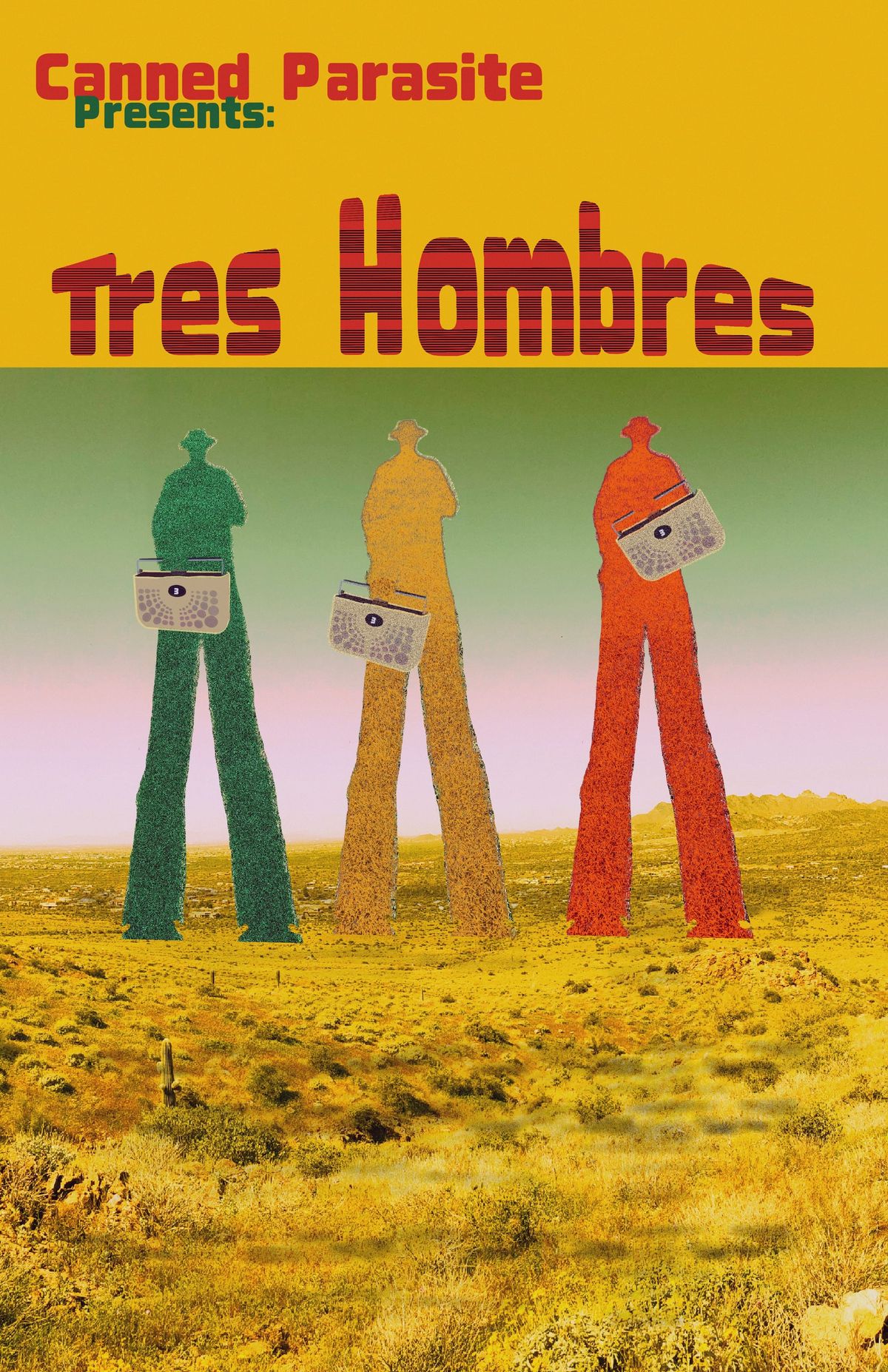
I am forever seeking that one additional elusive moment of hearing a particularly pleasing unique sound for the first time. I find this endless Odyssey of audio exploration enjoyable. I am an audio cosmonaut who prefers to sail the most turbulent seas. I also bask on the beaches of ambient glory. I travel from port to port looking for the most novel of auditorial pleasures. Sometimes I seek the simple pleasures of the auditory equivalent to home cooked comfort food. Primitive, modern or meta post modern primitive; I do not care which, as they all feed my soul.
I became afflicted with this condition in a rural community while standing in the music section of a local Woolco discount department store at the age of 7. The building for this local department store was as an unremarkable throw away nineteen seventies era warehouse looking building that was commonly used for strip malls of the time. The entirety of the color pallet for the store consisted of a similar shades of white and beige. White floors. White walls. White Ceilings. Every fixture, shelf, support post strove to reflect either the same shade of white or to assume a reserved neutral beige tone.
The carrier for the source of my infliction was an 8 track cassette that had the words Tres Hombres on the label. I had been scanning the selections of 8 tracks seeking the final band name amongst the last cassettes in the aisle. The cassettes were alphabetized by band name. I had combed through W-X-Y and there it was Z.
And behold. There it was. The final tape in the rack. Mission accomplished. Symbolized in singular 8 track representational glory. The band’s name was ZZ Top. I had no fucking clue what a ZZ Top was, but I was sold on ZZ Top due to th name alone. What kind of band had a name that started with two consonants and those two consonants were the last two letters of the alphabet? A cool band. That’s who. Though I did not have the vocabulary to express it at the time, I felt this name was entirely badass.
The 8 track.
That beautiful, substantial, nearly 5X4X1 inch, rectangular tape cartridge; audio preserved on an enclosed single loop of 1/4 inch tape held within.
8 track.
The stereo 8 cartridge that, almost magically, looped infinitely around after a determinant amount of minutes of audio play. Each track divided into equal parts of the 1/4 inch tape.
8 Track.
The medium that was so ruggedly bad ass it readily found itself a prerequisite for an American road trip experience by barging its way into the automobile. Hey, I’m 8 Track! I wanna come with you to Denver to see ZZ Top. I’ll just hop on in. Sorry Good Ol’ Record Player, only the cool dudes can come! You have to stay at home!” The 8 Track basically rode shotgun plus and told a good seat in the front row of the car, often right there under the radio, not far from the heater, so it could stay wam and cozy in the winter. This placement made it convenient for the driver to operate. While driving. The original distraction from our driving responsibilities. The utilitarian aesthetic of the 8 track made it car-tough, as were the tapes. The tape deck only held one 8 track cartridge at a time. Were you to want to swap out Saturday Night Fever with 50’s Oldies Goldies, no worries. Just toss Saturday Night Fever onto the floor. It’ll keep. Good enough mostly anyways. These tapes could generally handle a fair bit of abuse. Until they didn’t.
8 Track.
There is no medium quite as pleasurable to engage into action as those plastic thick ass bad ass 8 track tapes. Unlike their audio cassette tape descendants with their flimsy narrow ass tape and frail delicate bodies that required an even more frail so called “jewel” case to protect it; these 8 tracks were complete bastards you hastily slammed with gusto right into the tape deck. The tape deck would consume the cartridge as though it were an airlock suddenly thrust open on a space station. The deck would firmly but gently engage the capstan and pinch roller and, like a desireable lover, pull the tape through the reading heads. Through the wonders of concepts that I just barely understand- I am quite happy to share- magnetism is converted into sound. Through amplification we can hear its frequently blissful results. A nice warm sound. An appropriate sound for the automobile at that time. I contend the best place to listen to an 8 track is in a car. I hear there are apparently reasons for this.
8 track.
When not in the car we often listened to these same tapes using the same white color Panasonic 8 track player that everyone else seemed to also possess. It was disturbingly common at that time. The white plastic would eventually fade out into a petro-patina yellow over time. The deck could withstand a fair bit of abuse. You could toss it across the room onto the couch and if you missed and hit the shag carpet floor it would likely be none the worse for wear. You could power it using several batteries or plug it into the wall. It went both ways. Personally, I do not recall any reason we treated it as anything more than the utilitarian object that it was. It wasn’t like everyone wandered around saying “Look at my sweet shwank 8 track player!” It was a satisfying, dependable tool for a job. In that manner the Panasonic 8 track portable player was charming. But people didn’t make the fuss out of it that they did a few years later when a certain brand and model of audio cassette player arrived onto the scene.
Finding music prior to the digital age was an analogue only adventure. You most likely either purchased a tape or album because you had heard a song from that album on terrestrial radio (as there were not yet satellite options). Or maybe even at a Roller Skating Rink if you were a rink rat like I was for a couple of years.
Generally speaking, you could no pre listen to music prior to purchase. On occasion there were listening stations within a store with a handful of albums available to you to listen through headphones. And of course there was whatever was played over the store’s sound system as you roamed the confines of a proper record store and sometimes these would reflect the adventurous curations of a store employee showing their heightened tastes.
Music was not yet a banal commodity. There was no endless mindless audio streaming from small digital devices through small earbuds. There was no surfing the web looking for any and all music, human or computer generated, across a sea of digital domains and applications. There were no curated nor algorithmic playlist generations. Curation occurred almost exclusively through Disc Jockeys in radio stations organizing music for their listeners and sharing those results via the airwaves as they played these tracks off the records they had on hand. You had little say so in what you heard, beyond choosing one station over the other because you felt, at least at that moment in time, that it best catered to your musical preferences. In all other respects it was a one way transaction, including what commercials you heard. You could not instantaneously fast forward through a song. Nor instantaneously skip through several songs. Or mute a song from your life forever by demanding your device to never ever let the offending audio to breach your ear drums ever again. Nor could you immediately pick a new song amongst millions of other offerings. If you hated and despised what you were hearing on the radio at that moment in time your choices were limited. Turn the dial to a different station. Turn the radio off. Scream until despised song completed. Or wait quietly until the song passed along. Or slam an 8 track into the deck if you had such.
You could, at times, perhaps, call a request line if one was made available by the radio station. That could take a while. And require a phone call. Which was most often done in a house through a phone with a cable attached to the wall. Ours was maroon. And we bought an extra long cable so we could go from the kitchen to the living room for no reason in particular. There were no cell phones.
Commercials provided the revenue to keep the radio station’s lights on. The idea was that if a certain number of people in your commercial market were tuned in and listening during the time allotted for a given commercial to play, a certain number of those people would somehow give that business some money due to this exposure. If nothing else that commercial would at least generate some vague increase in traffic to that business on account that people had at least heard of its existence.
I need a plumber! Say, I heard Dan the Plumber is the Man. I remember him from the radio.
And off you go calling Dan the Man to fix your toilet issue. But how did Dan the Man come to be?
The radio station put the question to Dan in a business meeting to sell some advertising to Dan in exchange for some money. They sidled up to ol' Dan wearing. a tie and a business suit and “Say, Dan, how much is it worth to you, to have all of these captive listeners hear that it s YOU that are THEE Man, Dan?”
I betcha we got well over 5,ooo listeners tuning in at 7 a.m each weekday morning when they drive to their workplace each and every day! For a nominal fee, we will introduce each and every one of those 5,00o listeners to you each and every day, 6:58 a.m. in the morning. We will introduce them to you, to YOU, Dan. Dan, my man, what do you think of that plan?
Well, sign me up Mister Radio Man. I’m your man, Dan. I am THEE, Dan the Man.
Up through second grade I suspect I felt I was listening to the entirety of all the music that existed in the world via what I heard daily on the radio. I heard oldies like Buddy Holly. Really old oldies like the Glenn Miller Band. Classic rock music like the Beatles. Classic Classical music like that created by Mozart or Beethoven. A lot of modern rock and roll like Fleetwood Mac and their cohorts. Some Jazz I did not understand. And of course a full buffet of country music both old and new.
It took me a while to realize that there were far away places such as Denver where there was even more music than I could ever possibly imagine. I discovered this through hearing Bluegrass tunes played at bluegrass festivals on the eastern range of the state; these were songs I had never heard on the radio. After further studying the words on the 8 track tape’s labels and then listening to the songs on the tapes; I concluded that there was a great deal of music that rarely, if not ever, hit the radio airwaves.
Perhaps I was a bit slow on the uptake.
Nonetheless, I became very interested in listening to songs that I had not yet heard. They were curiosities to me, treasures of sound I had yet to encounter and plunder. Paradoxically, I also did not know they existed in any other manner other than theoretically. I could only infer they could possibly exist as I had yet to hear them. Only by scouring the entire planet would I be able to continually confirm or deny this as a truth.
There is a saying that goes something like “If there is a track on a tape but no one listens to it, does it really exist?” To which the answer is “It only matters if someone listens to it.”
I began spending more of my time listening to the 8 tracks in our collection looking for “new to me” songs. Generally, I would perform my research using our portable Panasonic 8 track player looking for these new tunes. Sometimes, however, I would sneak out into the Land Cruiser and listen to a song or two within its cubesque confines because I preferred the sound in the Land Cruiser over the house. The Land Cruiser was beige. (Red fades). I had to be careful when I did this, though. One time I turned the ignition key a bit too far and accidentally started the Land Cruiser while my mom was standing outside washing it at the car wash with one of those jet spray wands. Given the Land Cruiser was a fairly low geared manually operated vehicle, it started to slowly drive away, making its way, ever so gradually, out of the car wash even as my mom was standing outside of it and my sister and I were inside it. She had to hastily let go of the jet spray wand and run after the Land Cruiser before it slowly drove her children away from her. The jet wand kept spraying water everywhere as its long hose whipped around like the tail on the Alien creature in the Aliens movies as it violently smacked the side of the Land Cruiser. She was justifiably a bit mad at this unexpected misadventure. Fortunately she was able to commandeer the vehicle and bring it to a stop and then return outside and subdue the jet spray wand despite getting fairly wet in the process.
The majority of my family’s musical collection consisted of the boatloads of 8 tracks tapes that my mom acquired through a club that promised you wild things like 11 tapes for a single dollar bill! Granted there was the much smaller print: You also agree to purchase 8 more tapes at their regular price! Bah, details!
Another promised Six 8 tracks for a single penny! (RIP LITTLE PENNY!) But you had to promise to buy 4, only 4, more at regular price. And you had Three entire years! to do such. NO RUSH! And really, this is music we are buying, how cool is that? It’s a steal!
The world was an audio oyster farm with these clubs. Through these acquisitions my musical vocabulary slowly expanded beyond what the radio offered. The radio offered a more, shall we say, curated selection. A curious subset of a larger gene pool. The offerings in the larger gene pool were much more feral and raw.
Granted the gene pool in these tape clubs at that time were often filled with domesticated, mainstream, yet generationally diverse, selections. You didn’t find many edgy, controversial selections on offer. Certainly you were safe from the likes of a GG Allin. You were most likely to find yourself choosing between unsexy safe staples. Captain and Tennille. The Larry Gatlin Band. The Oak Ridge Boys. That one by Ferrante and Teicher that was a bunch of piano. Dave and Sugar. Etc.
To be sure, 8 track had its quirks. Most notably, the 8 track demanded karmic retribution from you if you had a desire to immediately demand a repeat of that really really good song you first heard on the radio. That single, was in fact the only reason you bought that cartridge. And you want to listen to it again. And again. And again.
The 8 track treated this as though it were a blasphemy to all of the remaining content on that cartridge. The 8 track did not permit you to rewind. IT FORBADE IT by refusing to even provide the option of doing such.
Instead, the tape demanded you either listen to the entirety of the collection of music, in the established permanent sequence, as the tape god intended; or you could chop off for several minutes of that listening experience by pushing a program button that would skip to the next track. Note the track is not to be confused with song, as the track could hold several minutes of audio, which could cover more than one song.
The mechanical sound of the tape deck as it moved across programs was quite pronounced. The endless loop of tape may be able to hold 45 to 60 minutes of audio spread across the programs of tracks, but splitting that time across 4 programs often yielded awkward results. Given the relative brevity of tape available for each track, it would sometimes abruptly interrupt the middle of a song with a large loud mechanical “CLICK” as the device switched from one program to the next. If you were lucky, songs would begin and end in such a manner that the silent gap between songs also aligned with the gap where the program changed. You would still hear the “CLICK”, but it wouldn’t disrupt a song. But it was just as likely these wouldn’t align. You could be listening to Dolly Parton singing “It’s All Wrong, But It’s All Right” and in the middle of the song “CLICK” as the player does its thing to move to the next program. Then you can hear this “CLICK” occur again during “Cowgirl and the Dandy”. And finally once again, “CLICK” , during “God’s Coloring Book”.
That said, some band’s took a stand and made sure their songs would not be interrupted on 8 track by these audible clicks. On Yes’s Fragile, for example, there is a note on the label after the track listing that reads “Due to Programming there is 1:00 of silence”.
The producer’s for Fragile even took the additional step to note the length of audio on each track as if to underscore “See? We did the best we could to make each program as equal as possible to provision the best listening experience possible. Program 1 is 10:34 and consists entirely of “Heart of the Sunrise.” Program 2 consists of everyone’s fave, “Roundabout”, as well as “Cans and Brahms”. Please note the latter are extracts from Brahms 4th Symphony in E minor. Specifically, the Third Movement. Ahem. This Program runs for 10:06. Program 3 is 10:00 flat. It is a doozy and consists of “Five Percent of Nothing”; “Long Distance Run Around”; “The Fish (Shindleria Praematuras)”; and “Mood for a Day”. Lastly, our 4th and final program consists of ”We Have Heaven” and ”South Side of The Sea” and it runs 9:34. But it results in the aformenention 1 minute of silence as you wait patiently for Program 1 to return. As you can mathematically, and clearly, see, we did our very best to limit the audio silence without subjecting you to a single “CLICK”within any of our songs. The maths work the best this way. Is that not what you want from us, Yes? Expect from us, Yes? Thanks!
The 8 track was arguably a symbolic monk in the world of strict audio martial arts. Should you heed its strict regiment and listen through each song as the tape god intendeed, the 8 track rewarded you by subjecting you to new songs and with this new opportunities to discover other wonderful songs that perhaps were not given the same opportunity as the song you had learned to enjoy from the radio that prompted you to purchase the cartridge. The inability to quickly return to a prior song meant it was often more preferable to listen to all, or at least most, of the songs rather than to attempt to skip onwards for the tastier nuggets. Each song was only going to be a few minutes long anyways. What’s the big rush! Your suffering would be rewarded with an expanded musical repetoir and obtaining figurative audio martial arts belts as you learned songs beyond those which were curated for radio listeners.
I always felt this type of listening strangely bold. You became a bit of a frontiersman as you ventured into lands that were unworthy of terrestrial radio airwaves.
Sometimes, honestly, it was painful. Like when you wanted to listen to Stevie Nicks belt out “Corn Dust Woman” again. And again. And again. But the 8 track’s compulsive limitations are what introduced you to the damn song to begin with as it wasn’t one of the singles played on the radio. No, you only became aware of the song by listening to the entire tape, all the way to what was originally the final song on Fleetwood Mac’s Rumours and that final song was indeed “Corn Dust Woman”. Some song you first heard in the dark roads of some Southwestern US desert. The song both captured your imagination of the desert and made you fall in love with Stevie Nicks and even the desert itself. All at the age of six years old.
8 track encouraged you to expanded your musical vocabulary and in turn that permitted you to judge for yourself what you did and did not prefer. It provided an escalated musical education of sorts. It turns out that there are many songs out there that are enjoyable that many people never hear. Over time we find that we are no longer surprised that we often find those more obscure cuts more interesting that their radio airplay counterparts.
It is not uncommon for most of us to be heavily encouraged by artwork when we are looking to discover new music. Much like a book cover, album sleeve art is there to entice us to part with our money over some veiled, often misleading, inference of what lies inside.
The artwork on ZZ Top’s Tres Hombres, simple though it appeared, also drew me to this album. The album artwork was fairly simple, but that simplicity was captivating to my simplistic seven year old self. Most of the album artwork I was exposed in those days were various poses and portraits of the artists themselves. The photos were often clear representations of the artists and attempted to infer they were attractive, and as such the album was attractive, and therefore, it would be attractive to possess something that adorned this image by parting with your money to obtain it.
The album artwork on Tres Hombres was more rustic than those images I usually encountered. In this instance you could barely make out the three guys whom were in the three different pictures that were present on the album cover. The photos were shot with a fair bit of over exposure so they are more than a bit blown out. But the effect made the three dudes in the three pictures seem much more bad ass because you had to postulate detail yourself. In one picture a dude with long dark hair is wearing jeans and is looking back at the camera while he sits on some rock someplace that is clearly arid. He seems to be looking at the camera in a “What the fuck are you taking my picture for?!” He is bad ass. It vaguely reminded me slightly of The Good, The Bad, and The Ugly and I loved that shit.
A second dude in a different picture was wearing a cowboy hat and appeared to be dressed entirely in denim clothing. He was facing away from the camera looking at the ground because he was a bad ass.
The dude in the center picture appeared to be wearing denim jeans as well and a hat of some sort. Who knows what he was actually doing, but to my eyes he appeared to be about to climb up a pole. And that looked like solid fun to my seven year old eyes and I envied his freedom to do such as I would certainly be discouraged from doing any such thing. I briefly wondered if this is what a lineman of the county looked like.
The words Tres Hombres were centered above the pictures. The lettering for some reason also reminded me of The Good, The Bad, and The Ugly. Beneath the pictures, centered, was the name of the band: ZZ Top. The lettering was, to my eyes, brown.
Interestingly, the entirety of the artwork is centered on the bottom two thirds of the entire cover. I think my eyes were drawn to the cover art it because most other covers I had encountered filled the entire cover with content. This album simply left the top third of it blank with only the green back ground to provide any visual interest. I liked how reserved and cool it seemed.
I grabbed the tape as though I understood the concept of “Must Have”.
I asked my mom, politely, if I could have this tape. She politely said ”No. That’s heavy metal and you wouldn’t like that.”
And that was that.
Sort of.
I felt the rationale for why the answer was ‘no’ sat on mighty shakey ground. The rationale I was provided was that I would probably hate it because it was a “Heavy Metal” band and the inference was that a little boy like me wouldn’t like that.
How could we know this out of hand? It bothered me that we were making some, I felt, unfounded assumptions.
Though I accepted that “No, I wouldn’t get this album,” I still gave it a fair amount of thought afterwards and concluded I did not accept that anyone could possibly know if I would or would not like it based on some predetermined probabilistic outcome. I did not know one way or the other if I would or would not enjoy listening to the sounds of ZZ Top as I had never heard it and therefor had no grounds to outright reject it. If I did not know, how could any one else, well intentioned or not, know? We could all have our opinions about me, but the only one who could figure this out and declare a result was me. And I knew the only way I could figure it out would be for me to listen to it.
It would be over 30 years before I actually listened to the entirety of Tres Hombres. Over that time the 8 track was unceremoniously displaced by the audio cassette which could accommodate much more music and took up much less space. And would play on devices that were much more svelte and portable than our utilitarian portable Panasonic decks.
During that 30 years a great many other things came and went in addition to the 8 track. Disco. Roller Skating rinks. New Wave. Miami Vice. VHS. Michael Jackson. Common sense.
There is no particular reason why it took me over thirty years to eventually listen to Tres Hombres. There were simply many other options and offerings that competed for my ears, money and time during those years and it took me a long while to eventually get to it.
At least I did eventually get to it.
I do enjoy the album. I had obviously heard several of its songs frequently over the years via various means. For me ZZ Top‘s “La Grange” captures the band best. It’s based off of a Blues Boogie rhythm called “Boogie Chillin’” by John Lee Hooker.
It turned out ZZ Top was a blues rock band before anything else.
Regardless of that thirty year gap between discovery and listening to it in its entirety, the album was nonetheless very influential in jumpstarting within in me a need to acquire, ascertain and consider a musical body of work through my own experience rather than having others determine its worth for me. It was fundamental in encouraging me to take chances on new music that I had not personally heard. I bought many other cassettes with the notion that I ZZ Top’s Tres Hombres symbolized the potential I may be missing something wonderful if the opportunity passed me by. Tres Hombres encouraged me to adopt an attitude of “You won’t really know for yourself unless you listen to it first.”
ZZ Top is one of those bands that keeps me honest about what I do and do not like. Along with their generational radio cohorts such as AC/DC, Steely Dan, The Eagles, and many others, ZZ Top falls into a category of well known influential bands that many people also find easy to dismiss. These bands are often reduced to a handful of well known tunes that are then seemingly inescapable over certain periods of time. They are often overplayed even by today’s standards. They play on several radio stations that offer an expanding array of what is included under “Classic Rock” and their songs are played all the time. Their fans constantly beat our heads in about how great they are. We tire of them. We like them fine, but we need more variety. We begin to avoid them. Many people also begin to deride them just to be mean.
I confess, I have had moments that lasted years where I avoided songs that became overly saturated over the airwaves. I avoided listening to ZZ Top for a good twenty years because I simply found it was the same 2-3 songs I had heard way too many times in a short period of time and that alone tainted my experience in their larger catalogue. That contributed to why it took me so long to listen to Tres Hombres.
ZZ Top‘s Eliminator, specifically, is one of those albums I should not enjoy for many years due purely from its overabundance on the airwaves for several years.
Let’s just say that while I fall well short of rabid fan status, over the years I have softened and now listen to ZZ Top’s Eliminator a couple of times a year. Eliminator is easily their most well known album, even if critics will most often choose Tres Hombres as their best output. Eliminator has a more distinctive sound that beckons the 1980’s and in particular mid 80’s era MTV programming. And from time to time I need that specific sound. I’ll generally cue up “La Grange” and then follow it up with the entirety of Eliminator.
Even though they were in peak popularity during the MTV era hey day, I love Eliminator even though it isn’t cool to say so. I associate the album with my desperate attempts to stay up late at night to see that one small window of music videos on that program called Night Flight, that showed what, 3 -4 videos. I first heard “Sharp Dressed Man” this way. Having no cable access, I couldn’t be choosey. Though I always thought the Police better typified the late night vibe at the time, I was grateful for a music video of any length. I am nostalgic for these late at night on the farm, tntirely dark except that cathode ray tube reflecting back at the dark room experiences.
I also found the women they sung about strangely alluring and powerful.
She’s got leg’s and she knows how to use them.
ZZ Top didn’t avoid the topic of women. Obviously. Quite the contrary. Women are sung about and appear constantly in every video and song. And while I find at times their lyrics get a bit obsessive about the innuendo and insinuations there of, their lyrics and videos never bothered me, because they often depicted men as the one’s with little shame or emotional control. These songs are basic horn dog expressions. ZZ Top love women. A lot. So much so they are shamefully desperate for female companionship at all times. But they seemed to stop well short of overt stalker cringey behavior. They were not desperate. They simply desired female companionship and were almost reverential in a very simple manner. They were not explicit. In this manner they contrast with, say, “Every Breath You Take” which is overtly predatory.
Even more so, I enjoy “Got me Under Pressure”. I feel that the woman described in this song had a strangely powerful hold on the man singing the song. And certainly this woman has him having met his match.
She's about all I can handle
It's too much for my brain
She's got me under pressure
Even more so, as the song progresses the ma expresses a fear for his physical welfare and is concerned he may find himself in a ditch on the side of the road at some point. Whoa nelly, what kind of woman is this that has this man under such fear that he is afraid to leave her even though he really probably should for his own wellbeing?
I love Billy Gibbons’s voice and he sells this construct with authenticity. I don’t care if it’s uncool to say so, but I’ll listen to that album again and again whenever I just need hear something with some grit and something clear and cohesive. Many deride Eliminator for having sacrilegious synthesizers and drum machines and loops, but I admired them for refusing to be reduced to an anachronism and laud them for being creative and adventurous.
It is just as well I hadn’t heard Tres Hombres earlier than I did. My understanding is that for many years during the infancy of the digital era, the only version available was a remixed version that was heavily derided by many as being inferior to the original recording, Given I first heard it in its entirety post 2010, I likely never heard anything other than original version given they eventually reverted back to the original 1973 recording.
I guess it all worked out best in the end even though I was sorely disappointed that day back in ‘77 when I was initially refused the opportunity to listen to this album.
Pink Floyd serendipity.
It had been many years since I had given the 8 track format any thought. In writing this piece, I had to go back and research it a bit as this format was most popular during my elementary school days and I was quite young at the time.
In the process of refamiliarizing myself with the format, I came across a comment that highlighted how the 8 track versions of songs in some instances were different than the formats on other mediums (which at the time were primarily in Vinyl format). This was often to overcome the dilemmas I describe above with how to align the programs on the tape in such a manner to reduce audio gaps or to invasively disrupt and split songs across programs.
One example of addressing these dilemmas pertained to the 8 track version of Pink Floyd’s “Pigs On the Wing”, a song found on their Animals album. The version of “Pigs on the Wing” found on the 8 track medium was longer than what appeared on the Vinyl version of the album.
Serendipitously, a couple of months ago a new Pink Floyd compilation album was released. I’m not generally into most of the more recently released Pink Floyd Compilations and rarely note them because I grew attached to Pink Floyd by listening to the bulk of their albums as cohesive conceptual albums that one listened to in context and in their entirety. Given my familiarity with their catalogue I’ve rarely ventured into their compilation albums.
However, this particular album happens to be entirely topical to the 8 track discussion.
The name of the album? 8-tracks. The album consists of, yes, 8 tracks, but more interestingly is that it also provisions the version of “Pigs on the Wing” that was originally only made available on the 8 track version of the album that was prevalent back in the 1970s. The version found on 8-tracks is not the identical version as it has been remixed and remastered and apparently includes some additional sound that was “lost” and then found on master tapes. Regardless, it is consistent with the offering that was found on the original 8 track version of the song.
The 8 track version includes a guitar solo that is not actually David Gilmour, but rather Snowy White and also includes Richard Wright also playing a Hammond organ, something that is not present on the Vinyl version.
The coincidental release of this album over this past summer provides an odd bit of completion for me with respect to the idiosyncratic 8 track format.